
The $1.3 Trillion Stimulus Dispute: Johnson Challenges Trump’s $5,000 Checks

$5,000 checks. $1.3T price tag. Zero congressional consensus. Here is how markets are pricing executive stimulus promises versus fiscal reality.
30-SECONDS VERSION
- The Proposal: The administration doubled down on its proposal to issue $5,000 dividend checks to all adult U.S. citizens if Republicans retain control of Congress—a sweeping stimulus measure with an estimated price tag exceeding $1.3 trillion.
- Get this “Fed ticker” before September 16 (Ad)
- The Fiscal Friction: House Speaker Mike Johnson publicly pushed back on claims that the executive branch can bypass the Capitol, confirming that any stimulus payout requires formal congressional authorization and budget reconciliation.
- The Capital Takeaway: Unfunded trillion-dollar stimulus proposals in an era of persistent inflation and 4.8% benchmark bond yields create direct friction for fixed-income markets.
- This Startup is Growing 23X Faster than Nvidia (Ad)
01 / THE INCIDENT
Executive Promises Meet Constitutional Budget Realities
The political rhetoric surrounding direct consumer stimulus has reached a multi-trillion-dollar ceiling.
Reaffirming his proposal before departing Ireland, the President declared that plans to send $5,000 checks to adult U.S. citizens are "going forward," claiming the executive branch possesses administrative mechanisms to execute the distributions independently.
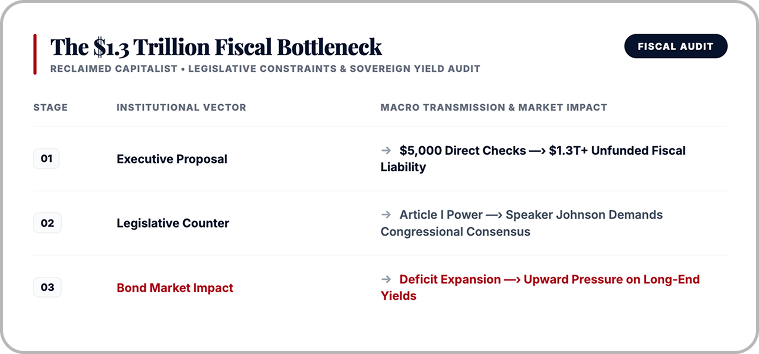
The House leadership immediately established a hard boundary. Speaker Mike Johnson countered on NBC’s Meet the Press, emphasizing that Article I of the U.S. Constitution grants the power of the purse exclusively to Congress. Any measure of this magnitude must undergo formal committee markup, scoring by the Congressional Budget Office (CBO), and legislative consensus.
To political commentators, this is a midterm campaign debate over consumer relief.
To capital allocators, it is a structural governance conflict over deficit expansion at a time when the federal debt burden already attracts intense bond-market scrutiny.
02 / THE CAPITAL LAYER
Unpacking the Math: $1.3 Trillion on a Strained Balance Sheet
To evaluate the feasibility of $5,000 dividend checks, allocators must look directly at federal debt mechanics and treasury supply constraints.
Sending $5,000 to approximately 260 million adult Americans creates an immediate $1.3 trillion fiscal liability. Without offsetting budget cuts or tax increases, this expenditure would be funded entirely through new U.S. Treasury debt issuance.
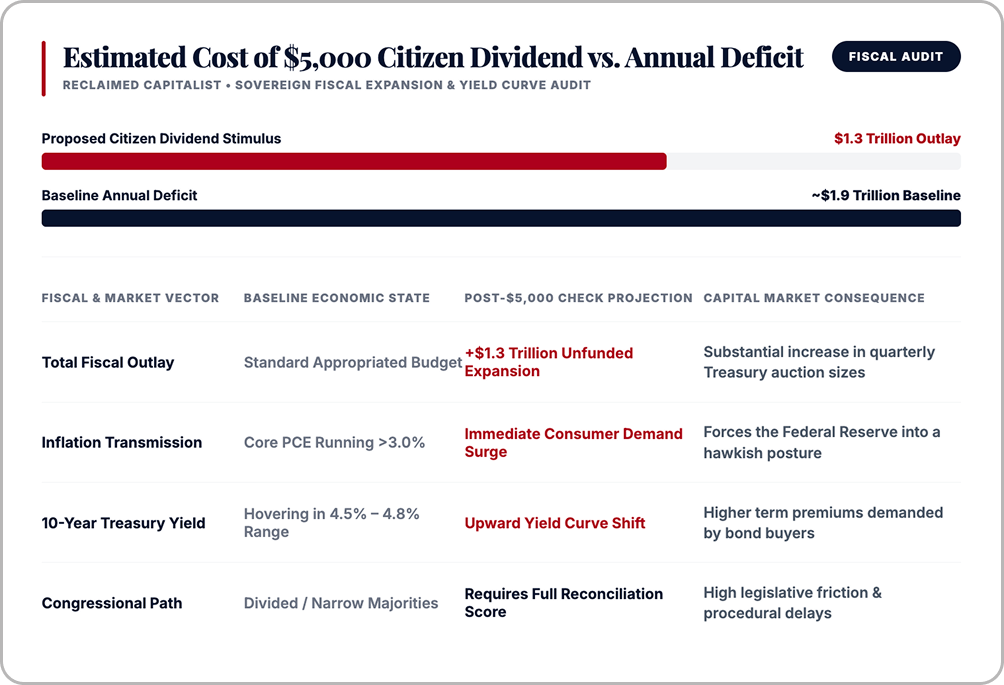
The secondary risk lies in inflation transmission. Injecting $1.3 trillion in liquid cash directly into consumer bank accounts while core inflation remains elevated would generate an immediate demand shock—complicating the Federal Reserve's mandate and delaying interest rate relief.
— Sponsored Briefing —
BofA: Digital Dollar Coming
Bank of America revealed your expiration date.
In their Bloomberg interview, said the digital dollar was inevitable.

Their exact words: CBDCs are an "inevitable evolution of today's electronic currencies."
The Federal Reserve has already asked for public comment. The infrastructure is being built as you read this.
Once the digital dollar launches, every transaction you make can be tracked. Your spending could be controlled. Your accounts could be frozen.
China already did this. Nigeria already did this.
But there's still a way to preserve your privacy.
I'm Tan Gera, ex-Wall Street banker and CFA© Charterholder.
I left the system when I saw what was coming.
Over 4,500 investors have already used this method to hold assets the government can't freeze and generate yields the Federal Reserve can't touch.
Watch how to access this escape hatch before it closes →
The window is closing.
P.S. Bank of America called the digital dollar "inevitable." Discover the easy method investors are using to escape →
03 / THE MECHANICS
Executive Authority vs. Legislative Appropriations
The claim that dividend checks can be distributed via executive order relies on novel interpretations of tariff revenues or emergency administrative funds.
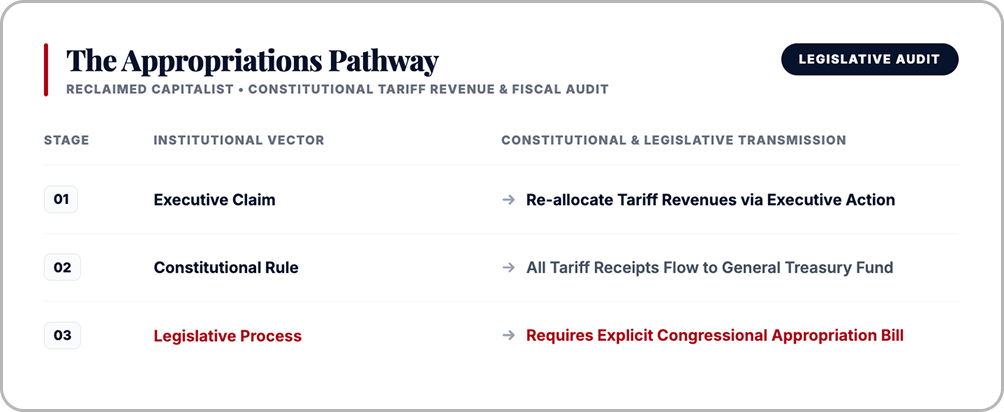
- Tariff Revenue Limitations: Customs duties and tariff receipts flow directly into the Treasury’s general fund. Re-directing those funds into individual consumer accounts requires explicit statutory authorization from Congress.
- The Reconciliation Hurdle: Even under a unified government, passing a $1.3 trillion spending measure through budget reconciliation requires strict Senate parliamentarian clearance and zero defectors within narrow congressional majorities.
04 / SOVEREIGN EXECUTION PROTOCOL
How to Position Your Capital Perimeter
As an Individual Sovereign, you do not model your personal financial strategy or business cash flows around speculative government checks. You track sovereign debt supply, protect against currency debasement, and maintain balance sheet independence.
- 1. Discount Speculative Stimulus in Financial Models: Exclude un-appropriated government dividend checks from household cash-flow forecasts and business revenue projections until legislation clears both houses of Congress and is signed into law.
- 2. Limit Exposure to Long-Duration Treasuries: Massive deficit-funded proposals put upward pressure on long-term benchmark yields. Avoid long-dated fixed income in favor of ultra-short Treasury bills.
- 3. Maintain Hard Asset Allocations: Persistent fiscal deficit expansion reinforces the long-term case for scarce physical assets, gold, energy producers, and infrastructure assets that preserve purchasing power.
Ignore headline promises, track legislative appropriations, and govern your balance sheet accordingly.
— Patrick Gibson
The Reclaimed Capitalist
— Sponsored Briefing —
This Startup is Growing 23X Faster than Nvidia

See this official SEC document? On page 146 Elon Musk revealed the name of a startup that Jeff believes will be…
The next monster IPO on Wall Street. (Click here to get the details.)
Even though this has nothing to do with robots, self-driving cars, or rockets…
This startup is growing faster than Tesla… faster than SpaceX… and even 23 times faster than Nvidia.
That's why The Atlantic called it…
"The fastest-growing business in the history of capitalism." (Click here to get the name, 100% free of charge.)