The $100B Paradox: Who Really Pays for Trump’s Venezuelan Oil Deal?
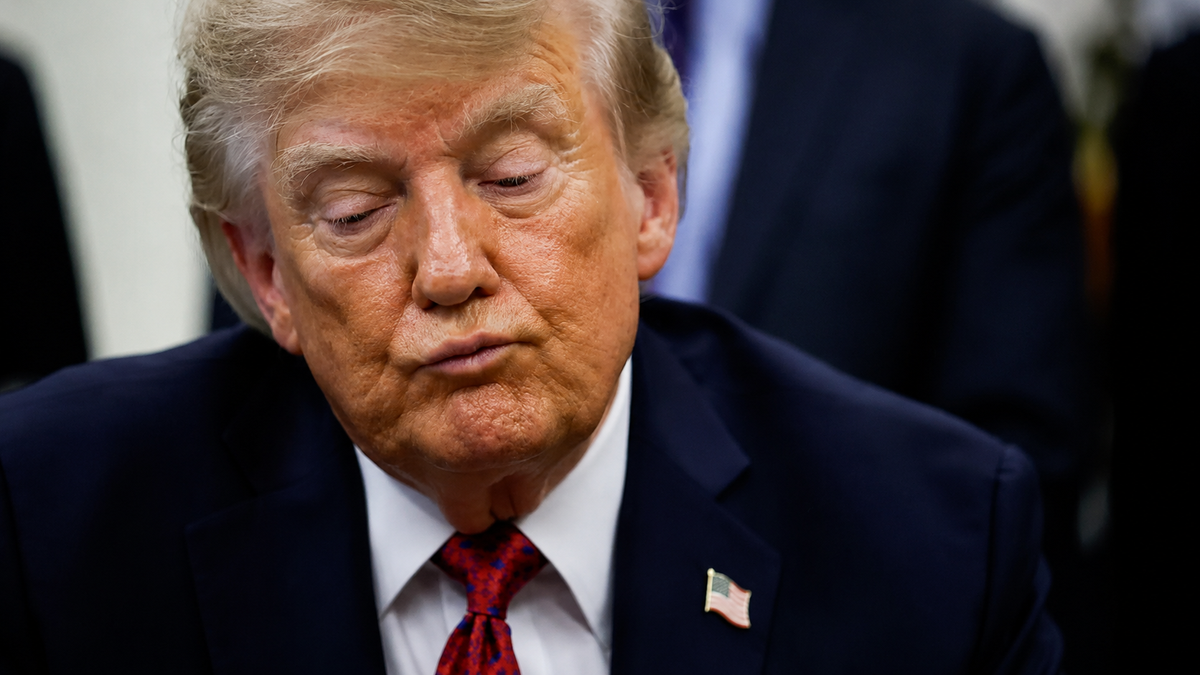
$100B needed. $0 from taxpayers. Oil majors sitting on their hands. Here is where the money actually comes from.
THE 30-SECOND EXECUTIVE BRIEFING
- The U.S. administration announced a deal giving Washington a 35% equity stake in North American Blue Energy Partners (NABEP)—a private operator handed 100-year concessions over 17 fields with 65 billion barrels of Venezuelan crude.
- Rebuilding Venezuela’s degraded power grid, upgrading infrastructure, and expanding exports requires $100 billion in private capital.
- What Your Financial Advisor Is Likely NOT Telling You about RMDs… (Ad)
- The $100B commitment will rely on commodity trade-house credit lines, oil-backed Pre-Export Finance (PXF), and ring-fenced special concession zones.
- This is the worst news for stocks in 50 years (Ad)
01 / THE INCIDENT
The $100 Billion Paradox in the "Biggest Oil Deal in History"
The political announcement was as massive as it was definitive.
In a joint declaration, the U.S. administration unveiled a landmark deal giving Washington an effective 55% output benefit—including a direct 35% equity stake in North American Blue Energy Partners (NABEP). NABEP was granted 100-year concessions covering 17 strategic oilfields containing roughly 65 billion barrels of reserves across the Orinoco Belt and Lake Maracaibo.
Promoted as the single largest energy deal in world history, officials promised the framework would channel $100 billion in private investment into Venezuela while securing a massive long-term crude pipeline directly into the U.S. Strategic Petroleum Reserve.
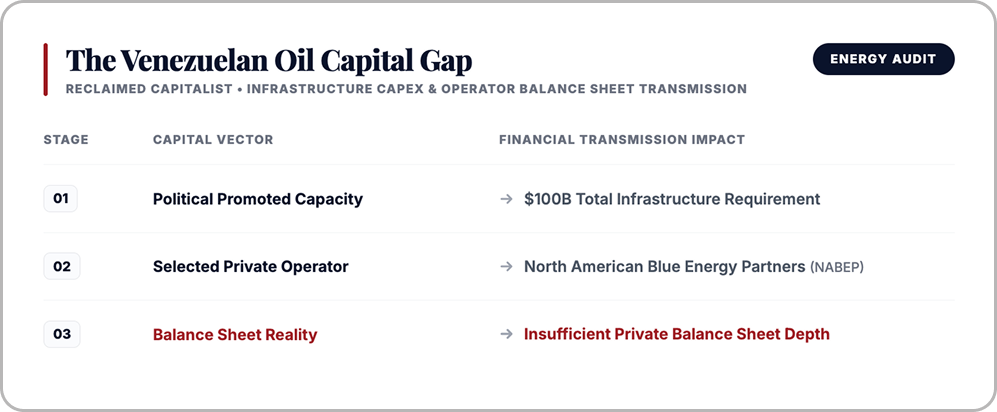
There is just one structural problem: Nobody knows where the $100 billion is actually coming from.
The administration has made one boundary clear: not a single dollar of U.S. taxpayer money will fund the buildout. Meanwhile, NABEP lacks the institutional balance sheet required to deploy $100 billion into a high-risk jurisdiction on its own.
An agreement can hand over reserve concessions on paper, but oil does not leave the ground on geopolitical press releases. It requires capital.
Sponsored Briefing
10 Million Coffee Trees. $26M in Revenue. Shares Are $1.10.
For $1,001, you can purchase approximately 910 shares of Green Coffee Company at the current offering price of $1.10 per share.
What does that give you exposure to?
45 Colombian coffee farms, consolidated together into the #1 largest producer in the country.
Around 10 million coffee trees.
Proprietary processing facilities capable of handling more than one million pounds per week.
A business that grew revenue from $1 million in 2021 to $26 million in 2025.
Products that have already reached more than 3,000 retail locations.
And exclusive third-party rights involving Juan Valdez roasted-coffee products across U.S. and Canadian retail and institutional channels.
This is not an investment in a café concept hoping to open its first location.
It is an opportunity to own shares in a vertically integrated coffee company already growing, processing, roasting and distributing Colombian coffee at scale.
Green Coffee Company is working to capture value across the supply chain — from the farm where the coffee is grown to the shelf where the finished product is sold.
Until recently, investments like this were often reserved for venture funds and wealthy accredited investors.
Today, individual investors can participate.
No accreditation is required, and the minimum investment is $1,001.
The company is still private, so liquidity is limited and returns are never guaranteed. But for investors who understand the risks, this is a chance to gain early exposure to an established coffee operation before a potential future liquidity event.
Click here to review the offering and see exactly what your investment buys.
This is a paid advertisement for Green Coffee Company's Regulation A offering. Please read the offering circular at https://invest.greencoffeecompany.com/.
Timelines are subject to change. Listing on the NASDAQ is contingent upon necessary approvals, and reserving a ticker symbol does not guarantee a company's public listing.
02 / THE CAPITAL LAYER
Why Wall Street Majors Are Refusing to Foot the Bill
To understand the delay, you must look at the capital expenditure budgets of the only entities capable of writing multi-billion-dollar checks: global integrated energy majors.
Rebuilding Venezuela’s dilapidated energy grid, degraded upgrader units, and rusting export terminals to scale production back toward 1+ million barrels a day requires $10 billion per year over a decade. That single annual allocation represents nearly half of ExxonMobil’s total global CapEx budget.
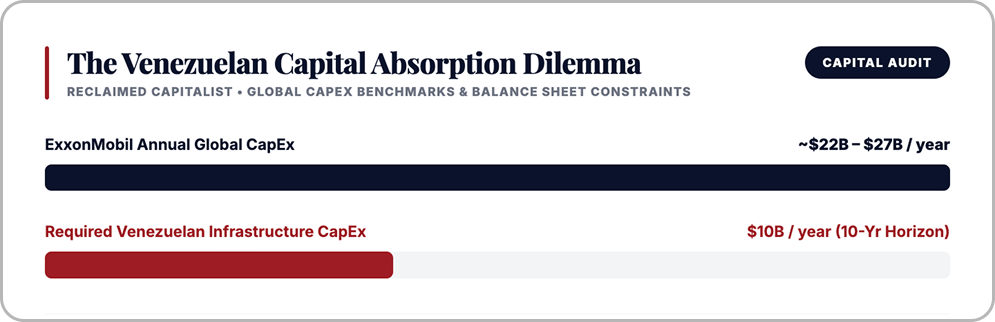
Why aren't major energy companies jumping at 65 billion barrels of reserves?
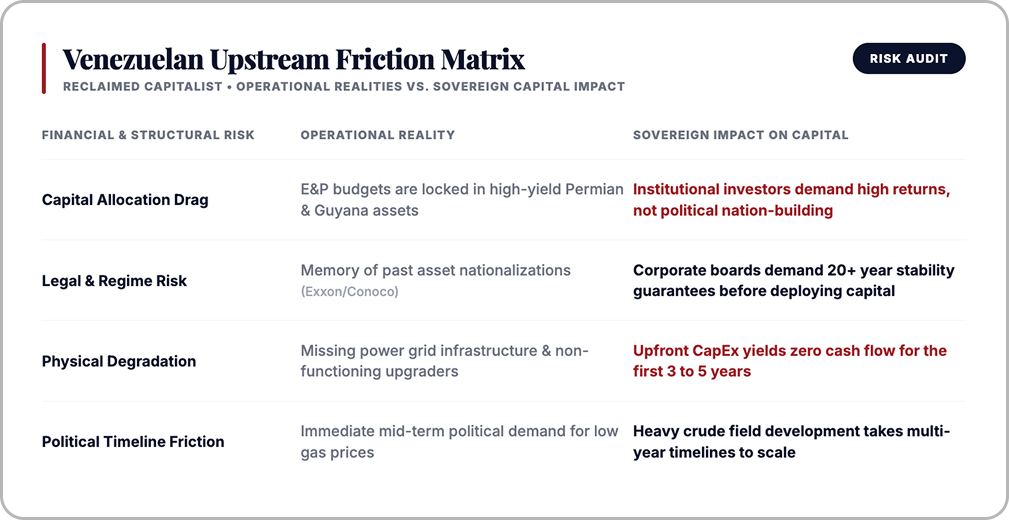
Corporate boards view capital deployment through a strict risk-adjusted lens. Without binding sovereign guarantees, institutional energy majors are treating Venezuela as a high-friction environment rather than an immediate capital priority.
03 / THE MECHANICS
The Missing Financial Bridge
If U.S. taxpayers aren't paying and public oil majors are treading carefully, the deal must rely on alternative capital mechanics.
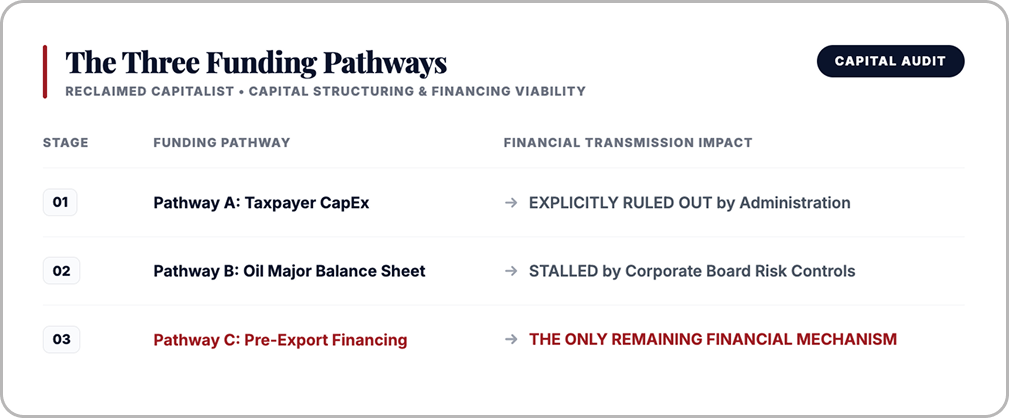
The remaining path to generate $100 billion without direct taxpayer cash or major equity CapEx runs through Pre-Export Finance (PXF) structures and commodity trade house syndications:
- Oil-Backed Sovereign Debt Securitization: Private commodity traders and specialized private equity consortia extend credit lines secured directly by future crude cargoes.
- Special Economic Concession Zones: The framework establishes ring-fenced 100-year legal jurisdictions within Venezuela, shielding operating field revenues from local political instability and legacy legal claims.
- Phased Cash-Flow Reinvestment: Instead of an immediate $100 billion capital injection, operators redirect near-term crude sales back into field repairs, extending the development timeline across decades.
This model works, but it moves slowly. It yields incremental barrel growth rather than a rapid surge in global crude supply.
Sponsored Briefing
Multiple Wall Street Banks Issue Disturbing Note to Clients
Wall Street’s declared what could be the worst news for the U.S. stock market in 50 years.
If Goldman Sachs and Morgan Stanley are right... this won't be like the crashes we're used to. What's about to hit America next could keep your portfolio in the red for 10 years or longer - unless you make a big change now.
To hear about this decade-long crisis now being predicted by multiple Wall Street banks...
And to see what you can do to prepare your wealth before this hits...
Click here to learn how to defend your portfolio.
Regards,
Keith Kaplan
CEO, TradeSmith
P.S. You may have noticed we see "surprise" crashes every year now. Think about it: rate spikes in 2022... the bank crisis in 2023... $8 trillion wiped out in 2024... $11 trillion wiped out during the tariff crash in 2025... and, this year, $12 trillion was wiped out in 30 days during the Iran War. Something is off and Wall Street suggests this could continue (and worsen) well into the 2030s. Click here to learn the truth about this market and see what you must do now to prepare.
04 / SOVEREIGN EXECUTION PROTOCOL
How Capital Allocators Should Position
As an Individual Sovereign, you do not price your portfolio based on speculative headlines or political timelines. You track physical capital deployment and supply reality.
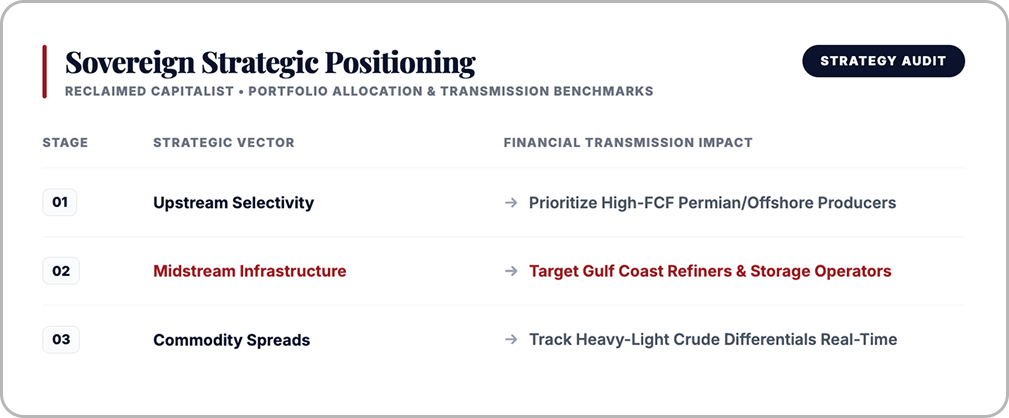
- 1. Discount Immediate Global Supply Spikes: Do not price an immediate crash in global crude futures based on Venezuelan reserve announcements. Rebuilding heavy crude capacity requires years of physical construction before hitting meaningful export volumes.
- 2. Focus on Gulf Coast Refiners with Existing Feedstock Access: Complex refiners along the U.S. Gulf Coast win if incremental heavy barrels move, regardless of who finances the $100 billion buildout. Position in operators with advanced coking assets.
- 3. Demand High Return on Invested Capital (ROIC) from Energy Holdings: Avoid oil majors that attempt to fund high-risk, multi-billion-dollar international rehabilitation projects out of operating cash flows without strict legal protections. Favor companies returning excess capital via buybacks and dividends over speculative political CapEx.
Govern your capital around physical execution, not policy promises.
Patrick Gibson
The Reclaimed Capitalist