
The U.S. captures $15.1T. Hardware refreshes overtake real estate. Grid constraints become the new bottleneck.
THE 30-SECOND EXECUTIVE BRIEFING
- PwC’s landmark Global Data Centre Outlook projects cumulative AI infrastructure capital expenditure reaching $31.6 trillion through 2050, accelerating from ~$800 billion annually in 2026 to $1.8 trillion per year by mid-century.
- The United States is projected to capture $15.1 trillion (nearly 48%) of total global outlay, leveraging its silicon ecosystem, deep private capital markets, and early hyperscaler scale.
- Wall Street Is Getting Ready for Its Next Huge IPO (Ad)
- Unlike legacy infrastructure booms (railroads, telecommunications, interstate highways) that taper off after physical construction, AI compute represents an endless operational treadmill.
- Trump’s $4,290 Secret (Ad)
01 / THE INCIDENT
This Is Not a Construction Project — It Is a Permanent Capital Treadmill
When the market evaluates massive infrastructure cycles—whether it’s 19th-century railways or 1990s fiber-optic rollouts—the playbook is historically linear: build the physical assets, deploy the capital, and then sit back to harvest high-margin cash flow as CapEx drops.
PwC’s forecast shatters that traditional framework.
The firm’s central case maps a cumulative $31.6 trillion global spend (with a high-adoption upside of $50 trillion). But the structural signal isn't just the sheer size of the headline number; it's the composition of the balance sheet.
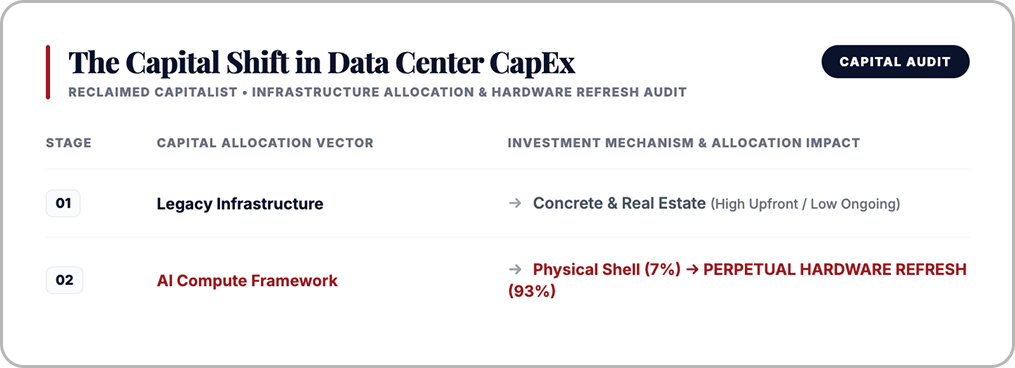
In typical real estate or utility developments, concrete, land, and steel dominate the capital stack. In AI infrastructure, the physical shell is a rounding error over a 25-year horizon. Compute hardware, custom silicon, high-bandwidth memory, and liquid-cooling arrays must be ripped out and replaced every 48 to 72 months to maintain performance-per-watt efficiency.
By 2050, 93 cents of every dollar spent on data centers will go directly to silicon, server, and networking upgrades.
Sponsored Briefing
Wall Street Is Getting Ready for Its Next Huge IPO
The next great IPO frenzy could be just weeks away.
Anthropic is reportedly preparing to unveil its IPO prospectus shortly after Labor Day.
And its actual IPO could follow in …
Late September or early October.
At a valuation as high as … $2 TRILLION.
If that happens, you can probably imagine what comes next.
The headlines.
The TV hype.
The rush to buy.
But before you join that rush …
There's something Michael Robinson says you need to know.
He calls it …
The Big IPO Lie.
Because the people who stand to make the biggest money from Anthropic may have gotten in long before the public ever gets its chance.
And Michael has uncovered a different way to approach Anthropic's potential IPO …
… BEFORE it hits the public market.
With Anthropic's next IPO move reportedly coming shortly after Labor Day …
There may never be a better weekend to see how it works.
Click here before Anthropic rings the opening bell.
02 / GEOGRAPHIC DISTRIBUTION
The Geography of Compute: The U.S. Unlocks the Lion’s Share
The report breaks down how the central $31.6 trillion projection distributes across major global regions:
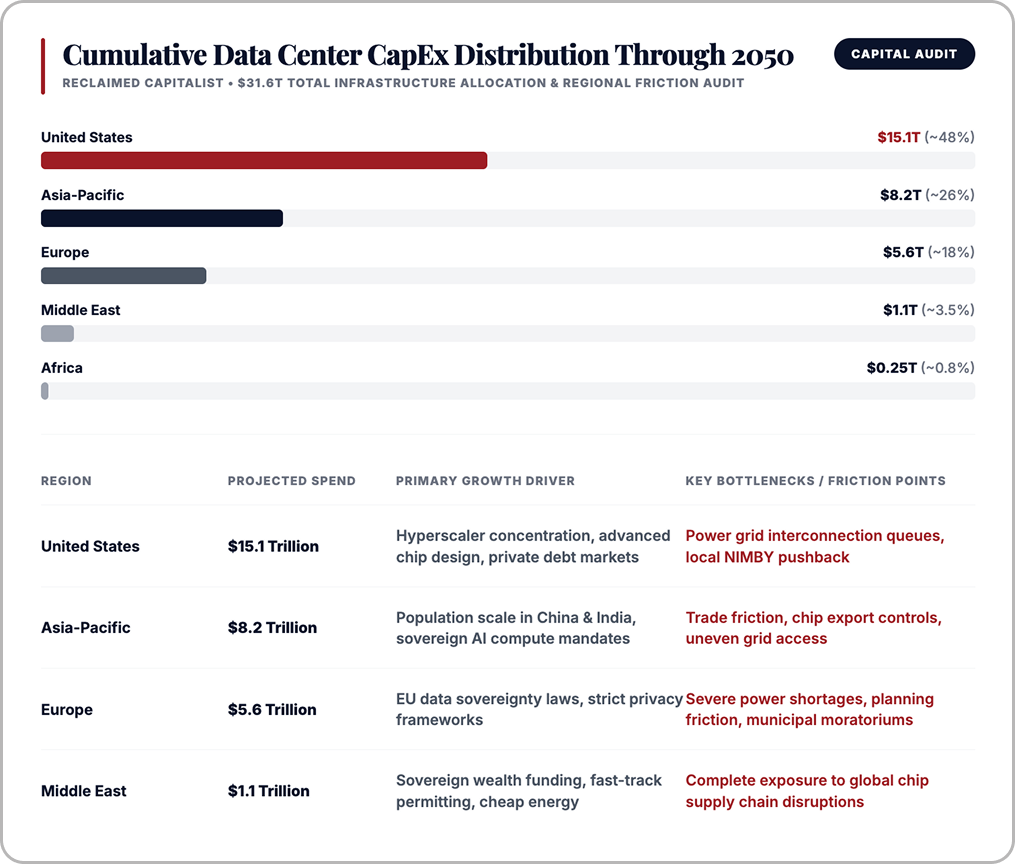
Europe’s structural underperformance ($5.6T) stands out sharply. Fragmented regulatory environments, high electricity costs, and municipal bans on new data center developments mean the continent continues to punch below its economic weight in compute capacity.
03 / THE BOTTLENECK
The Great Power Strain: Megawatts Are the New Currency
While Wall Street focuses on GPU supply chains, the real constraint on this $31.6 trillion pipeline is physical power.
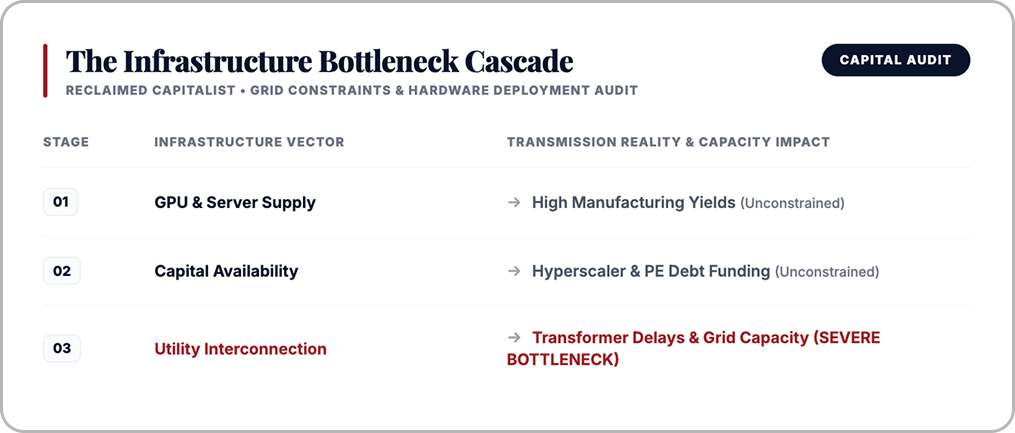
Power availability has emerged as the primary determinant of where capital actually settles. Data center developers are running directly into utility interconnection backlogs that can stretch from 4 to 7 years.
This supply-demand mismatch is triggering a massive structural shift:
- The Rise of "Behind-the-Meter" Power: Hyperscalers are increasingly bypassing public utility grids entirely, co-locating data centers directly at nuclear power plants, natural gas processing facilities, or dedicated geothermal fields.
- Repricing Baseload Power: Utilities with nuclear, natural gas, and hydroelectric capacity are securing long-term Power Purchase Agreements (PPAs) at substantial premiums above wholesale rates.
- Community and Political Pushback: Local resistance to rising consumer electricity bills and industrial land use is creating political friction, forcing developers to look toward sovereign energy hubs like the Middle East or energy-rich U.S. states.
Sponsored Briefing
Trump Issues Emergency Order That Supports Elon Musk's Next Venture
Without most people noticing, Elon Musk has started a new venture that has nothing to do with rockets, EVs, Neuralink, or tunnels.
Trump has personally issued emergency support to roll this underlying tech out as fast as possible.
It's already live in multiple states.
Behind the scenes, demand for this is already spiking...
The Financial Times says Sam Altman is begging people on the phone to build this for him and OpenAI.
And the best part for you and your wealth is:
A few little-known companies control the supply chain.
Anyone who wants this tech - be it Sam Altman or even Elon himself - must go through these companies to get it.
You can simply buy their stocks right now... before this news becomes common knowledge.
But you ought to move fast. Because leaked satellite images are already showing up online...
Click here to see how you could back Elon Musk's next venture from your regular brokerage account.
04 / SOVEREIGN EXECUTION PROTOCOL
How to Position Capital Across the $31.6 Trillion Treadmill
As an Individual Sovereign, you do not need to guess which individual AI software application wins long-term. You allocate capital to the physical layers that must be continuously funded to keep the machine running.
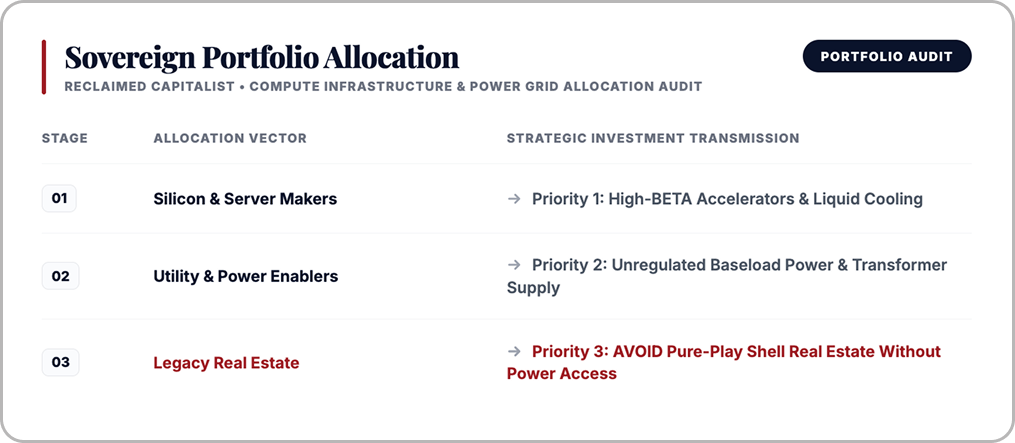
- 1. Overweight the Hardware Refresh Cycle: Because 93% of capital flows into technology gear rather than concrete, maintain core exposure to custom silicon designers, high-bandwidth memory (HBM) suppliers, advanced packaging fabricators, and specialized liquid-cooling manufacturers.
- 2. Own the Baseload Power Gatekeepers: Target independent power producers (IPPs), regulated utilities with expanding capital expenditure baselines, and grid infrastructure suppliers (transformers, high-voltage switchgear). Energy is the bottleneck; those who control megawatts hold the pricing power.
- 3. Avoid "Empty Shell" Data Center REITs: Be cautious with traditional real estate investment trusts (REITs) that lack guaranteed grid interconnection queues or direct power access. A stadium-sized facility without a power contract is a non-performing asset.
Position your portfolio where capital must be spent.
Patrick Gibson
The Reclaimed Capitalist