The ultimate IPO unicorn before Labor Day Ends (AD)
Venture capitalists call a private company worth over $1 billion a unicorn.
$10 billion and it’s a decacorn.
$100 billion is a hectocorn.
But what do you call a private company worth over a trillion dollars?
Anthropic is there, right now.
The first of its kind.
It’s worth more than every American airline — combined.
It’s even bigger than the U.S. defense budget …
Anthropic’s annualized revenue grew by 80 times in the first quarter.
They’ve already filed the paperwork for an IPO …
Some estimates say they are going public as early as October.
Now, here’s what’s really exciting.
You can take a stake in this IPO …
Right now.
Today.
At an extremely discounted price.
As part of our Labor Day Savings Event …
You can learn everything you need to know for just $29.
That’s 94% off the retail price.
When you take advantage of this special offer, you’ll also get:
➢ A full year of my monthly tech newsletter, Disruptors & Dominators
➢ Monthly stock recommendations
➢ Timely alerts and updates
➢ Four special reports on how to take advantage of this opportunity
Anthropic has the potential to be the biggest IPO in history.
With some experts saying it will reach a $3 trillion valuation.
But if you wait to buy Anthropic on day one …
You’re missing out on the real opportunity.
A way to get a piece of the action …
BEFORE it goes public.
For a chance to see gains on day one.
Click here to take advantage of this special offer.
Michael Robinson
Director of Tech Strategies
Weiss Ratings
P.S. Anthropic is expected to go public in October. You’ll want to position yourself before then. This 94% discount expires Monday night. Get the urgent details while you can.
01 / THE INCIDENT
The Post-Labor Day Reality Check
Labor Day weekend marks a seasonal line in the financial calendar.
The summer slowdown ends, trading desks refill, and corporate capital expenditure strategies for the upcoming fiscal year are locked in. But as the holiday travel spike clears, the transport landscape itself is undergoing an operational shift.
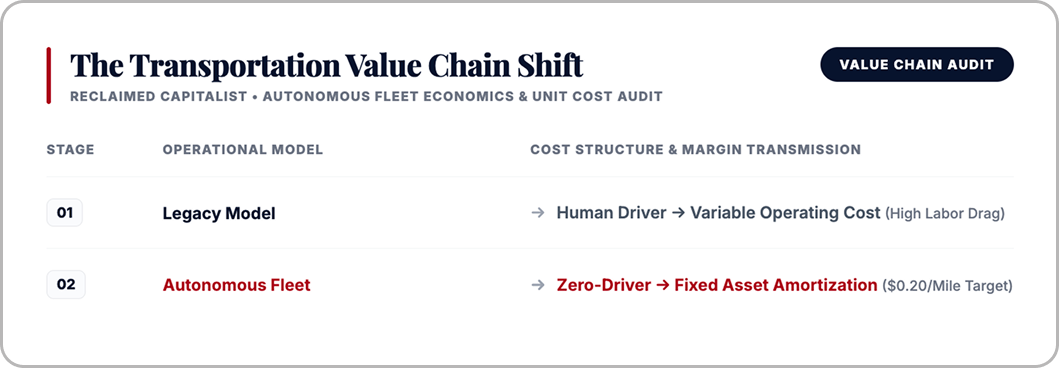
While millions of travelers navigated congested highways and airport terminals over the weekend, Tesla officially crossed the threshold from prototype demonstrations to commercial monetization. In Austin, Texas, the company launched its initial paid commercial fleet of Cybercabs—two-passenger autonomous vehicles constructed without steering wheels, pedals, or traditional driver controls.
To mainstream observers, this is an interesting headline about self-driving cars.
To capital allocators, it represents the beginning of a fundamental re-pricing across urban logistics, ride-hailing platforms, and municipal transport infrastructure.
02 / THE CAPITAL LAYER
The Economics of the Steering-Wheel-Free Fleet
To understand why the Cybercab launch matters to markets, you must look past the vehicle's gold-bronze exterior and butterfly doors to evaluate the underlying operational balance sheet.
Ride-hailing economics have historically been constrained by human labor costs. Driver payouts account for roughly 70% to 80% of total ride fares on legacy platforms. By removing driver controls entirely, autonomous fleet operators shift the business model from variable labor expenses to fixed asset amortization and energy logistics.
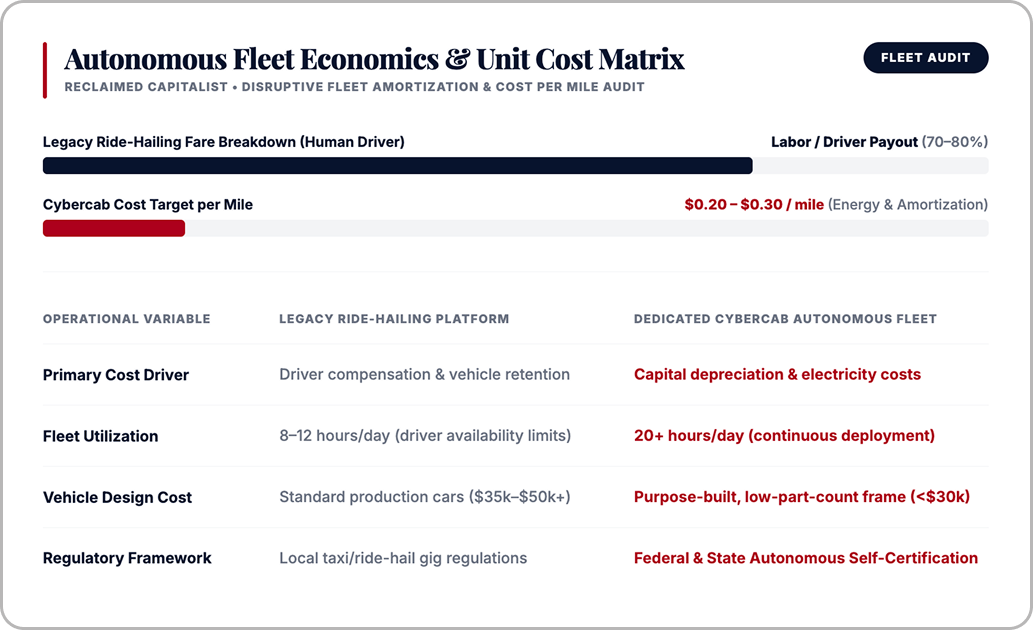
By building a dedicated two-seat vehicle optimized exclusively for autonomous point-to-point transport, the capital cost per mile drops dramatically. If scaled effectively, sub-$0.30 per mile operating costs disrupt not only traditional ride-hailing networks, but personal vehicle ownership models in dense metropolitan markets.
03 / THE REGULATORY & COMPETITIVE FRICTION
Hardware Scale vs. Regulatory Hurdles
Despite the initial commercial deployment in Texas, the path to multi-million-unit scale faces immediate structural friction.
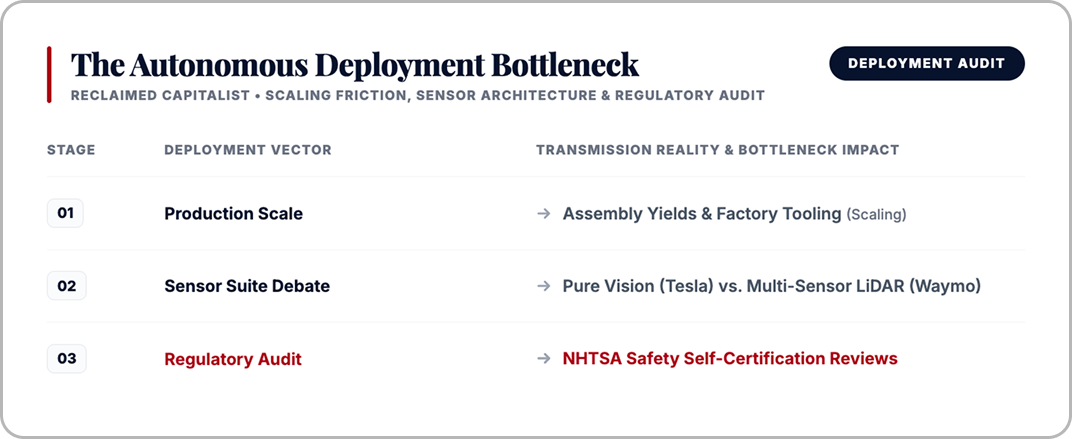
- The Regulatory Audit: Removing traditional driver controls shifts 100% of operational liability to the manufacturer. Federal regulators, including the National Highway Traffic Safety Administration (NHTSA), have opened formal audits regarding safety self-certification standards for vehicles lacking manual controls.
- The Vision vs. LiDAR Battle: Tesla’s reliance on pure computer vision (cameras) and neural network processing directly contrasts with competitors like Waymo, which utilize multi-sensor stacks including LiDAR and radar. The capital implication is significant: vision-only hardware keeps vehicle production costs low, but must prove equivalent safety margins across all weather conditions.
- Manufacturing Scaling: Operating pilot fleets of dozens or hundreds of units in Texas is vastly different from achieving volume production targets exceeding 100,000 units annually.
Sponsored Briefing
Starbucks’ 400× Lesson for Coffee Investors
In 1992, Starbucks went public at a split-adjusted price of approximately $0.27.
Today, its stock trades above $108.
That’s a gain of roughly 40,000%.
Put another way…
That turns $100 into $40,000…
$500 into 200,000 dollars…
And a tiny stake of $1,000 into almost half a million dollars.
But unless you invested in Starbucks back in 1992, that opportunity is already gone.
The bigger question is:
Where could coffee’s next major growth story come from?
The global coffee market is projected to reach approximately $380 billion by 2033. And its next breakout company may not be built around thousands of cafés.
It may begin with the farms…
And that’s the opportunity that could dwarf Starbucks returns.
Click here to see what a $1,000 stake buys today – and why this company believes the next big coffee story is moving from farm to shelf.
Meet Green Coffee Company.
It owns approximately 45 Colombian farms and 10 million coffee trees.
It also holds exclusive third-party rights Juan Valdez coffee products across U.S. and Canadian retail and institutional channels.
Those products are already reaching Target, Walgreens and thousands of North American retail locations.
And individual investors can now own a stake while the company is still private.
No accreditation required.
Invest in Green Coffee Company before 9/30 and own a piece of the $380B coffee market.
This is a paid advertisement for Green Coffee Company's Regulation A offering. Please read the offering circular at https://invest.greencoffeecompany.com/.
Timelines are subject to change. Listing on the NASDAQ is contingent upon necessary approvals, and reserving a ticker symbol does not guarantee a company's public listing.
04 / SOVEREIGN EXECUTION PROTOCOL
Positioning Capital for the Autonomous Transport Transition
As an Individual Sovereign, you do not allocate capital based on technological enthusiasm or headline promises. You track margin structures, identify asset owners, and position capital where physical cash flows shift.
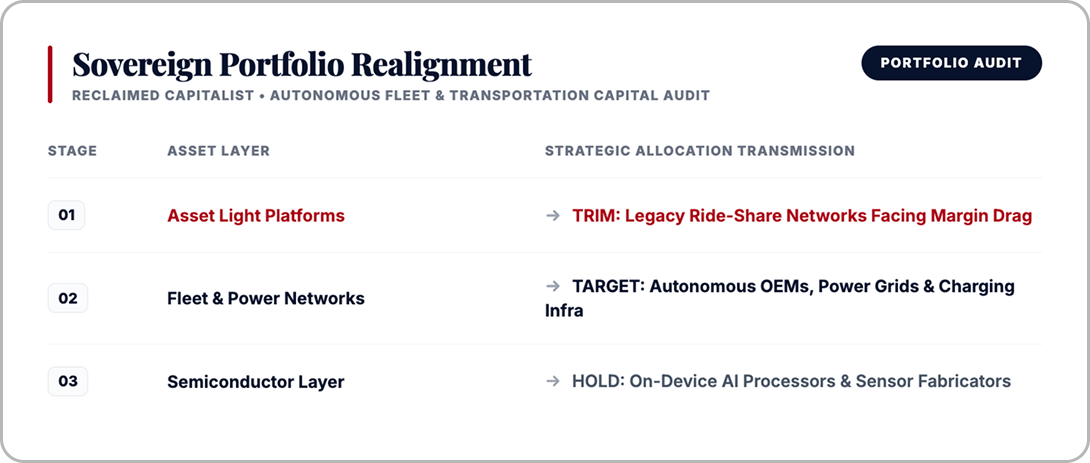
- Audit Legacy Ride-Hailing Exposure: Re-evaluate equity positions in asset-light ride-hailing platforms that rely exclusively on human drivers. Companies that do not control their own autonomous hardware or software stack face long-term take-rate compression as autonomous fleets expand.
- Target Infrastructure and Grid Enablers: Autonomous fleets running 20+ hours a day require specialized charging infrastructure, automated fleet maintenance hubs, and expanded local grid connections. Allocate capital toward regional power producers, high-voltage equipment suppliers, and fleet management operators.
- Monitor Autonomous Mileage Milestones: Track quarterly paid autonomous miles and regulatory clearance updates across key states (Texas, California, Florida). Commercial monetization milestones serve as the core catalyst for institutional re-ratings across the autonomous mobility ecosystem.
The post-Labor Day market is pivoting from summer consumption to structural infrastructure deployment. Align your portfolio with physical cash flows, monitor fleet scaling, and govern your capital perimeter accordingly.
Position your portfolio where capital must be spent.
Patrick Gibson
The Reclaimed Capitalist