The Fed’s New Regime: No Guarantees, No Bailouts, No Guidance

30-SECONDS VERSION
- The Headline: Fed Chair Kevin Warsh warned inflation remains "too high" and affirmed price stability as the central bank's top priority.
- The Policy Shift: Declaring forward guidance has "overstayed its welcome," Warsh ended pre-committed rate paths and signaled the Fed has "work to do" if inflation does not cool fast enough.
- The Takeaway: The Fed will no longer safety-net risk assets with forward signaling. Allocators must price assets on underlying balance sheet cash flows rather than central bank promises.
- Warning From an American Father (Ad)
The era of central bank hand-holding is officially over.
Delivering his debut keynote address at the Jackson Hole Economic Symposium as Federal Reserve Chairman, Kevin Warsh drew a sharp line in the sand regarding U.S. monetary policy.
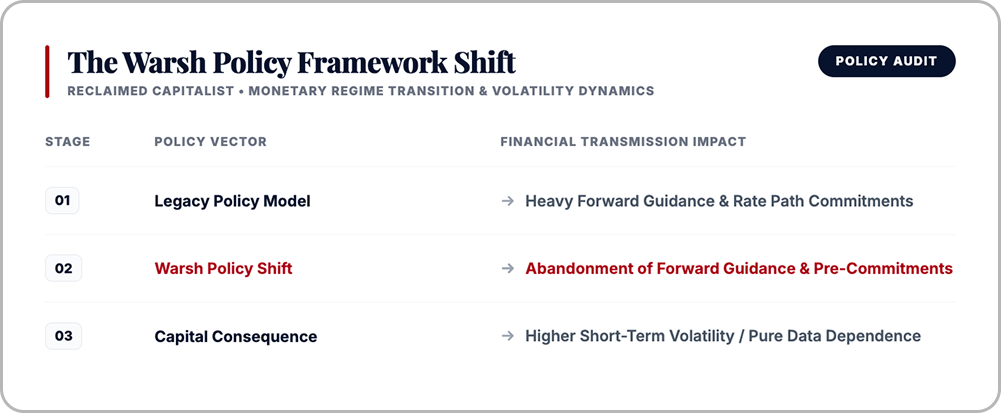
For years, market participants relied on the Federal Reserve to issue precise, forward-looking interest rate roadmaps—a practice known as "forward guidance." Warsh dismantled that paradigm in a single speech. Stating plainly that forward guidance has "overstayed its welcome" and creates "ambiguity in the name of clarity," Warsh committed the Fed to a data-driven, outcome-focused posture where policy will be judged purely on results.
The underlying message was uncompromisingly hawkish: U.S. inflation remains too high, and price stability is the central bank's primary duty.
To the financial press, this speech was a routine monetary update.
To capital allocators, it represents a structural regime change. The Federal Reserve will no longer act as an insurance policy for risk assets through pre-announced easing cycles. The central bank has signaled it will act when necessary to curb inflation—unfiltered by market expectations.
The Intelligence Brief: Media Narrative vs. Macro Mechanics
Let’s look past media spin and evaluate the underlying economic data presented by the central bank.
What the media claims: The Fed Chair delivered a balanced assessment of a resilient economy while keeping options open for upcoming Federal Open Market Committee (FOMC) meetings.
What is actually happening at the capital layer: Warsh pointed out that summer inflation metrics have failed to demonstrate meaningful progress toward the 2% target. Over the past 12 months, 54% of goods and services in the Personal Consumption Expenditures (PCE) basket recorded annual price increases above 3%.
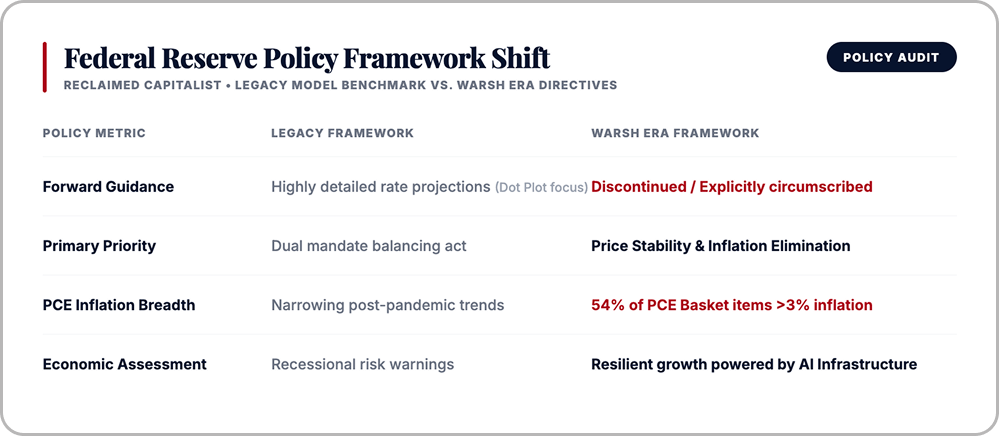
Warsh observed that current financial conditions are hard to classify as strictly restrictive. With the labor market remaining stable and job gains tracking workforce expansion, the Fed views inflation as a problem requiring potential monetary tightening rather than immediate rate cuts.
— Sponsored Briefing —
92% of this smart-home category is still manual
Smart thermostats went mainstream.
Smart doorbells followed.
But one major part of the home has barely been automated at all.
92% of window shades are still manually controlled.
RYSE is going after that gap with patented technology designed to automate the window coverings people already own.
No replacing every shade. No opening walls. No electrician required.
And RYSE has already sold more than 100,000 devices and generated $20 million+ in revenue, with 10 granted patents protecting its technology.
Now everyday investors can invest in RYSE at $2.50 per share.
That price has a deadline.
RYSE says its current share price is set to change August 31.
EXPLORE THE RYSE INVESTMENT OPPORTUNITY BEFORE AUGUST 31 →
Important disclosures. This is a paid advertisement for RYSE Inc. made pursuant to a Regulation A+ offering and involves risk, including the possible loss of principal. The valuation is set by the Company; there is currently no public market for the Company's Common Stock. Nasdaq ticker "$RYSS" has been reserved by RYSE; any potential listing is subject to future regulatory approval and market conditions. Past share-price appreciation does not guarantee future returns. SEC qualification does not constitute SEC approval of the merits.
RYSE Inc., 96 Spadina Avenue, Suite 500, Toronto, ON M5V 2J6, Canada
The Tactical Strike: The AI Productivity Boom vs. Price Pressures
The Infrastructure Paradox
A central theme of Warsh's economic breakdown focused on the unprecedented scale of technology capital expenditure.
The Federal Reserve Chair highlighted the surge in high-tech CapEx—driven by massive infrastructure spending in artificial intelligence—as a key driver of economic resilience. However, this productivity boom presents a unique challenge for monetary policy:
- The Supply-Side Boost: In the long term, AI-driven productivity gains can expand economic capacity and reduce unit production costs.
- The Near-Term Demand Shock: In the short term, gigawatt-scale data center construction, specialized hardware procurement, and energy grid expansion generate massive immediate demand for physical commodities, specialized labor, and electricity.
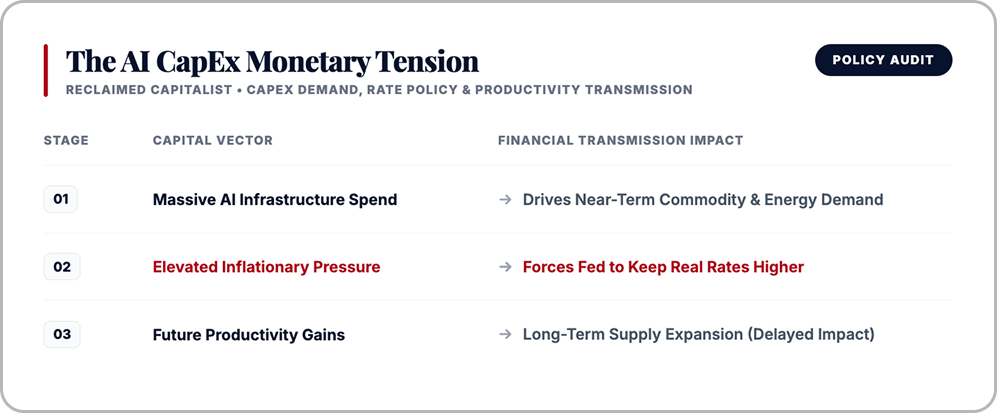
By acknowledging AI as a major new factor of production, Warsh signaled that high capital investment may keep baseline real interest rates elevated for longer than markets previously priced in.
The Operational Shift: Why Removing Guidance Changes Market Dynamics
The Mechanics of Central Bank Discretion
For over a decade, financial markets operated under a system where central bank communications functioned as a de facto market backstop. When macroeconomic data softened, explicit forward guidance signaled rate cuts well before policy shifts took effect.
By eliminating this signaling framework, Warsh introduces structural volatility into short-term rate markets:
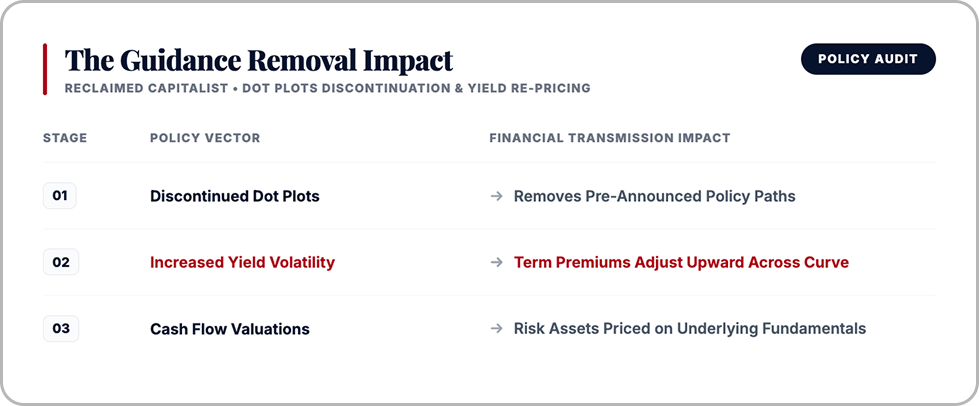
- Increased Rate Volatility: Without explicit guidance, short-duration interest rates and bond yields will fluctuate dynamically around incoming economic reports rather than settling into pre-guided expectations.
- Higher Yield Curve Risk Premiums: Institutional investors can no longer price risk based on central bank guarantees. Term premiums on long-dated debt must adjust upward to compensate for policy discretion.
- Data-Dependent Asset Pricing: Risk assets—particularly high-multiple equities and growth sectors—must be valued on cash flows rather than anticipated monetary policy support.
This structural shift requires allocators to focus on balance sheet strength rather than attempting to front-run central bank policy moves.
The Corporate Weaponization: The Death of the Central Bank Safety Net
The Capital Allocation Disruption
For over a decade, corporate treasury departments and private equity sponsors operated under the assumption that the Fed would step in with dovish signaling at the first sign of market distress.
By ending routine forward guidance, Warsh has intentionally removed this safety buffer.
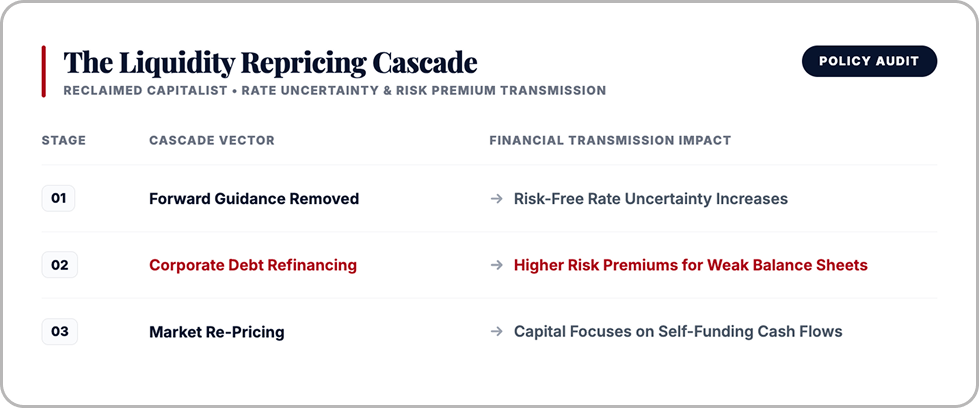
Without explicit rate-cut roadmaps from the Fed, corporate balance sheets can no longer rely on cheap debt refinancing cycles. Corporate entities with high leverage, weak coverage ratios, or speculative business models will face rising credit spreads, while highly liquid, self-funding firms will command a distinct valuation premium.
The Global Macro Ripple: Currency Alignment and Capital Flows
Cross-Border Capital Mechanics
The Fed's hawkish pivot and refusal to offer dovish guidance reverberate far beyond domestic markets. International central banks—many of which have already begun easing cycles—now face widening interest rate differentials against the U.S. dollar.
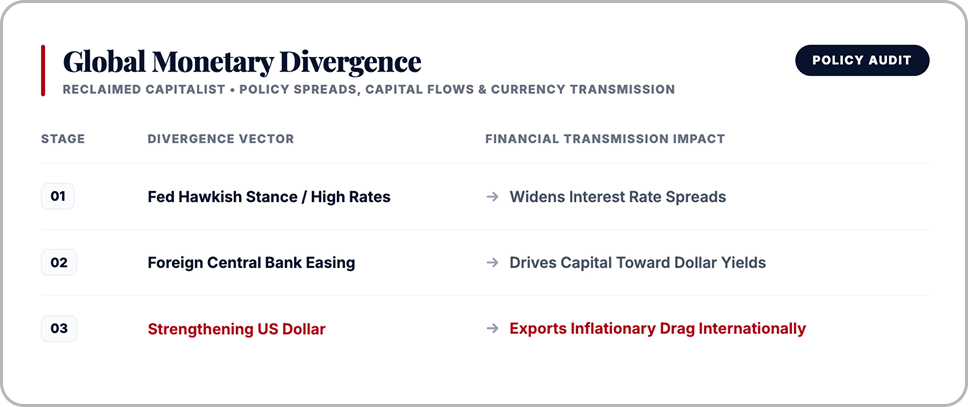
- The Dollar Yield Advantage: As long as the Fed holds baseline rates firm to combat sticky core PCE inflation, the U.S. dollar retains an yield advantage over foreign currencies.
- Emerging Market Capital Pressure: High U.S. real rates tighten global financial conditions, raising foreign-denominated debt service costs for emerging market sovereigns and corporations.
- Commodity Pricing FX Drag: A resilient dollar creates headwind mechanics for global trade volumes, even as structural demand for energy and industrial metals remains supported by infrastructure spend.
The Sovereign Directive: Portfolio Positioning
The Execution Blueprint
As an Individual Sovereign, you do not build a financial strategy around central bank promises or speculative forward guidance. You align capital with balance sheet discipline and macro realities.
The Sovereign Execution Plan:
- 1. Eliminate Reliance on Rate-Cut Predictions: Disregard short-term consensus bets on Fed rate cuts. Warsh has made it clear that policy will remain tight until underlying inflation trends demonstrably clear the 2% bar.
- 2. Audit Debt Maturity Schedules: Review all fixed-income and corporate equity positions for refinancing risk. Companies requiring immediate capital raises in a "higher-for-longer" environment face severe margin compression.
- 3. Maintain Hard Asset Allocations: With structural inflation pressures persisting across core PCE categories, maintain dedicated exposure to cash-flowing infrastructure, energy providers, and hard monetary assets.
- 4. Stress-Test Equity Holdings for Rate Volatility: Re-evaluate equity positions trading at high multiples relative to free cash flow yield. In an environment without forward guidance, high-valuation assets carry elevated drawdown risk during inflation surprises.
Ignore market noise. Respect the death of forward guidance, audit your leverage, and guard your capital perimeter accordingly.
Patrick Gibson
The Reclaimed Capitalist