Trump’s Energy Accord: Heavy Crude, Strategic Reserves, and Gulf Realities

30-SECONDS VERSION
- The Headline: The U.S. administration announced plans to use oil from a newly brokered energy deal with Venezuela to replenish the Strategic Petroleum Reserve (SPR), which sits near a 44-year low of roughly 290 million barrels.
- A better and cheaper way to take RMDs (Ad)
- The Macro Mechanics: U.S. Gulf Coast refineries — engineered specifically for heavy, sour crude — face structural feedstock deficits.
- The Takeaway: The move highlights a shift toward resource pragmatism over strict geopolitical isolation.
- Warning From an American Father (Ad)
Geopolitics and energy infrastructure have once again converged at the balance sheet layer.
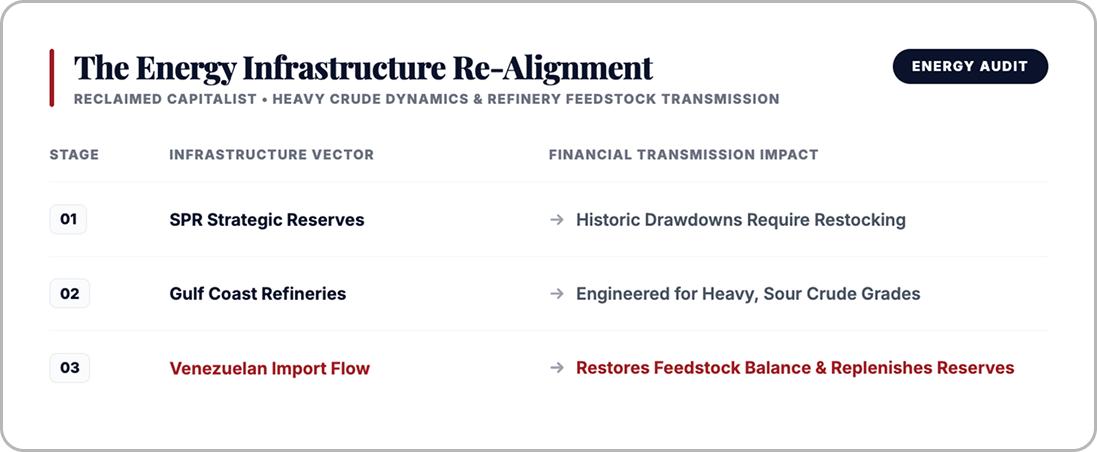
The U.S. administration announced plans to utilize Venezuelan oil imports to replenish the depleted U.S. Strategic Petroleum Reserve (SPR). Following historic drawdowns that brought national emergency reserves to multi-decade lows, the administration is pivoting toward regional heavy crude sources to restore inventory buffers.
To mainstream commentators, this announcement is a political headline about foreign policy reversals.
To capital allocators, it is a structural acknowledgment of physical refining realities. The U.S. industrial refining complex—particularly along the Gulf Coast—was constructed to process heavy, sour crude slates rather than the ultra-light, sweet crude produced across domestic shale basins.
Securing heavy crude access directly addresses refining yield efficiency while filling physical storage tanks.
The Intelligence Brief: Media Narrative vs. Physical Supply Realities
Let’s look past ideological debates and analyze the physical supply chain dynamics driving this policy move.
What the media claims: The administration is making an ideological reversal purely to lower domestic gasoline pump prices ahead of economic evaluations.
What is actually happening at the capital layer: The Strategic Petroleum Reserve requires millions of barrels of heavy-grade crude to restore operational flexibility. Permian and Bakken light crude cannot single-handedly optimize Gulf Coast complex refiners without significant blending adjustments.
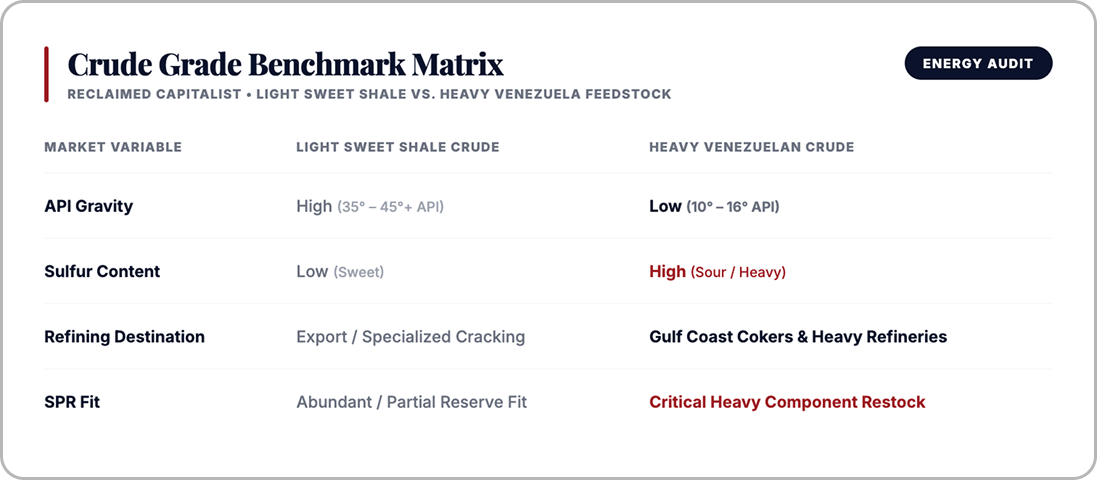
By securing direct allocation of heavy crude slates, the U.S. energy framework stabilizes domestic refining margins while acquiring barrels at structured pricing terms.
— Sponsored Briefing —
Could This Start-Up be the Next Amazon Acquisition? [Limited Offer]

Imagine skipping out on Ring before its $1.0B buyout by Amazon
Kevin O’Leary called it the worst mistake in Shark Tank history.. a 67,765% return missed!
By the time we hear about industry-changing companies, it’s usually too late. But right now, there’s a smart home startup making their way to homes in America. This tech startup is RYSE, and unlike Ring, you can still invest early – before it takes off.
Like how Ring disrupted home security, this company is revolutionizing smart blinds & shades- with $20M+ in revenue, 70% annual growth, and sold in 100+ retail locations across the US & Canada.
🔒 Lock in $2.50/share before Aug 31 →
Important disclosures. This is a paid advertisement for RYSE Inc. made pursuant to a Regulation A+ offering and involves risk, including the possible loss of principal. The valuation is set by the Company; there is currently no public market for the Company's Common Stock. Nasdaq ticker "$RYSS" has been reserved by RYSE; any potential listing is subject to future regulatory approval and market conditions. Past share-price appreciation does not guarantee future returns. SEC qualification does not constitute SEC approval of the merits.
RYSE Inc., 96 Spadina Avenue, Suite 500, Toronto, ON M5V 2J6, Canada
The Tactical Strike: Gulf Coast Refining and Spread Compression
The Refining Economics
Complex refiners along the U.S. Gulf Coast achieve their highest profit margins when processing discounted heavy crude.
When heavy crude supplies were constrained due to sanctions and reduced production across traditional exporters, refiners were forced to adjust operations or pay premiums for alternative heavy slates (such as Canadian Maya or heavy Middle Eastern grades).
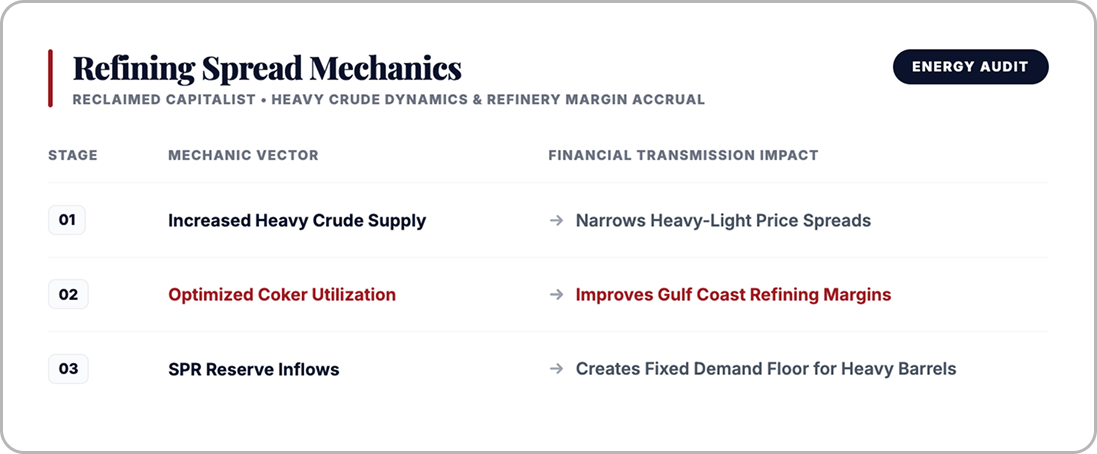
- Yield Optimization: Gulf Coast cracking and coking units extract high-value distillate fuels (diesel, jet fuel) efficiently from heavy slates.
- Price Spread Compression: Injecting Venezuelan volume into the North American refining corridor narrows the spread between light benchmark crudes (WTI) and heavy grades, lowering raw feedstock costs for domestic operators.
The Corporate Weaponization: Midstream Infrastructure and Shipping Assets
Capital Flow Realignment
Re-establishing heavy crude trade corridors requires physical midstream infrastructure, tanker capacity, and maritime logistics.
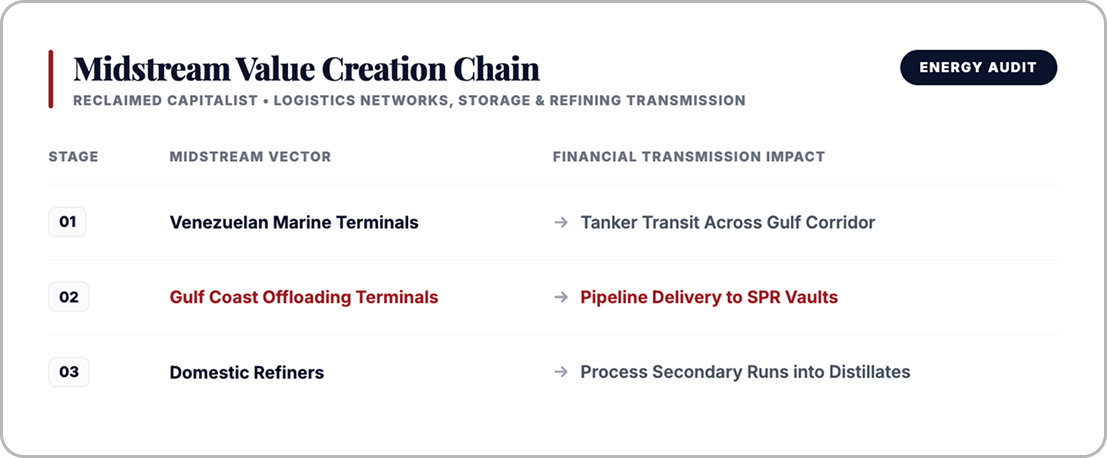
Entities controlling Gulf Coast marine terminals, offshore offloading berths, and heavy-crude pipeline connections stand to capture increased throughput volumes. Furthermore, specialized tanker fleets designed for heavy crude transport will see heightened utilization across short-haul Caribbean-to-Gulf routes.
The Global Energy Chessboard: Pragmatism Over Containment
Geopolitical Capital Flows
This arrangement marks a broader shift in sovereign energy policy: resource security and domestic reserve stabilization taking precedence over strict market isolation.
- The Reserve Security Mandate: A depleted Strategic Petroleum Reserve limits macroeconomic flexibility during supply shocks. Replenishing the SPR is a critical security imperative.
- Monetization of Sanctioned Assets: Allowing controlled crude flows under direct US oversight ensures energy flows are channeled into regulated refining systems rather than informal shadow-market networks.
The Sovereign Directive: Portfolio Positioning
The Execution Blueprint
As an Individual Sovereign, you do not evaluate energy news through political sentiment. You map physical supply chains, identify infrastructure bottlenecks, and position capital where cash flows clear.
The Sovereign Execution Plan:
- 1. Audit Gulf Coast Refiner Exposure: Focus on complex refiners possessing advanced coking capacity. These operators gain a direct cost advantage when heavy crude supply expands.
- 2. Track Midstream Throughput Assets: Evaluate energy infrastructure operators controlling Gulf Coast storage hubs, marine offloading terminals, and heavy-oil pipeline routes.
- 3. Monitor SPR Restocking Rates: Track official Department of Energy reporting on weekly SPR inventory changes. Steady reserve build-rates establish a persistent demand floor for global crude volumes.
Ignore the political commentary. Track physical crude slates, follow refining margins, and guard your capital perimeter accordingly.
Patrick Gibson
The Reclaimed Capitalist